
Introducing Apex: An Operating System for Your Life’s Work

Ambitious people do not have a motivation problem. They have a coordination problem.
The mission is in one document. The projects are in another. Tasks are scattered across three apps. Notes disappear into a folder. Important relationships live in someone else’s CRM. Health data sits on a phone. Weekly planning happens when there is time. Reflection happens when something goes wrong.
Then AI arrives and adds another blank text box.
You can ask it anything. It can answer almost anything. But it still does not know what you are trying to build, what matters this week, what you promised yesterday, or which part of your life is quietly sliding backward.
The intelligence is powerful. The operating system is missing.
That is why I built Apex.

Apex is an AI-powered command center for founders, operators, and builders. It connects the long arc of your life to the work directly in front of you: life areas, missions, projects, tasks, rituals, knowledge, relationships, planning, execution, and review.
It is not another productivity app with an AI button attached.
It’s an attempt to build the missing coordination layer for a high-agency life.
Productivity Tools Organize Fragments
The modern productivity stack is good at capturing fragments.
Calendars organize time. Task managers organize obligations. Notes apps organize information. Habit trackers organize repetition. CRMs organize relationships. Journals organize reflection.
Each tool works within its own boundary. The problem is that your life does not.
A task belongs to a project. A project should move a mission. A mission exists within an area of life. The work consumes time and energy. Progress changes what should happen next. Relationships affect the outcome. What you learn should shape the plan.
When these relationships are spread across separate systems, you become the integration layer.
You spend mental energy reconstructing context:
What was I trying to accomplish?
Why did this project matter?
What did I decide last week?
Who am I waiting on?
Which commitment should I drop?
The cost is larger than administrative friction. Fragmented systems weaken judgment. They make urgent work appear important and visible activity feel like progress.
A long task list can hide a drifting mission.
That is the deeper problem Apex is designed to solve.
The Missing Layer: an Operating System
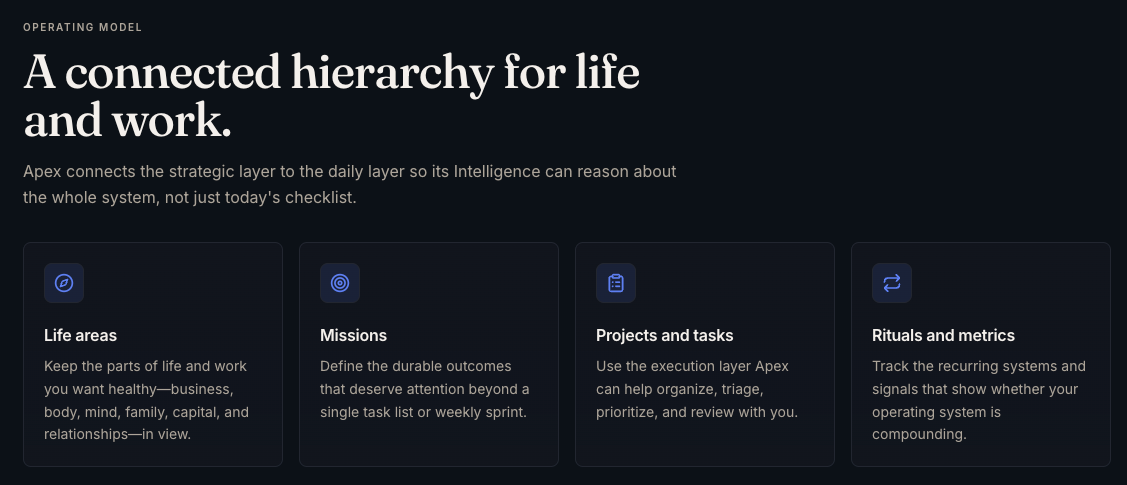
An operating system does not just store files. It coordinates resources, maintains state, manages permissions, and gives applications a shared environment in which to work.
A personal operating system should do something similar.
It should connect purpose to execution. It should remember what matters, show the current state of the system, and help allocate scarce resources: time, attention, energy, money, and trust.
That requires more than a dashboard.
The system needs structure.
In Apex, the structure begins with Life Areas: the domains you are responsible for maintaining. Business. Wealth. Body. Mind. Relationships. The exact categories matter less than the discipline of seeing your life as a portfolio of systems rather than one undifferentiated list of demands.
Within those areas sit Missions: meaningful outcomes with a longer horizon.
Missions become Projects.
Projects become Tasks.
Tasks enter the daily command center.
Then the system closes the loop through Review.
This hierarchy is simple by design. The value comes from maintaining the links. A task is not just something to complete. It is a unit of execution attached to a larger intention.
That changes how you choose.
From Task Management to Mission Management
Most productivity software begins with the task. Apex begins with the mission.
What are you trying to achieve?
The distinction matters because tasks multiply faster than judgment. There is always another message to answer, document to revise, meeting to schedule, or small problem to fix. A capable person can spend an entire week completing real work without advancing anything important.
Mission management forces a harder question:
What is this work in service of?
Apex does not eliminate task management. It gives tasks a place inside a larger operating model.
The Daily layer includes Command, Plan, and Review.
Command shows what needs attention now. Plan helps shape the week and allocate work deliberately. Review turns activity into feedback by showing what shipped, what slipped, what changed, and what deserves another decision.
The Life Operating System holds Life Areas, Missions, Projects, and Tasks.
The Intelligence layer adds a Chief of Staff, Knowledge, Pulse, and Relationships.
These are not separate product categories forced into one menu. They are different views of the same operating system.
Knowledge gives decisions context. Pulse makes important signals visible. Relationships preserve the human network around the work. Review converts experience into memory. The Chief of Staff helps reason across the whole system.
The goal is not to put your life into software.
The goal is to reduce the coordination burden required to run it well.
AI Should Work Inside the System
The first generation of consumer AI taught us to have better conversations with machines.
That was useful. It was also incomplete.
A chatbot knows what you type into the current window. A chief of staff should understand the operating context around the question.
If you ask, “What should I focus on this week?” the quality of the answer depends on more than the prompt. It depends on your active missions, unfinished work, recent reviews, current capacity, known constraints, and commitments to other people.
The model is only one part of the system.
The real product is the harness around it: memory, structured data, permissions, workflows, failure states, confirmation rules, and human judgment.
Apex places AI inside that harness.
The Chief of Staff can help reason about priorities. It can prepare operating briefs, support weekly planning, search your knowledge, and draft relationship communications. But consequential actions remain approval-first.
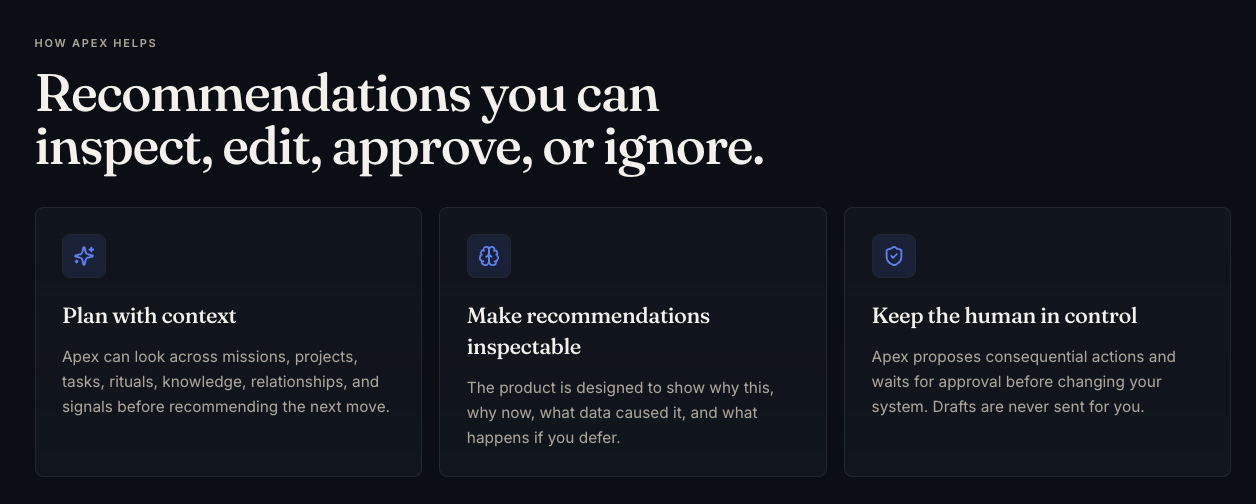
Apex proposes. You decide.
That boundary is intentional. I do not want software quietly reorganizing someone’s life because a probabilistic model generated a confident sentence. I want AI to increase the quality and speed of human judgment without pretending judgment is no longer necessary.
The user remains the operator.
The Core Loop
A useful operating system needs a repeatable loop.
In Apex, that loop looks like this:
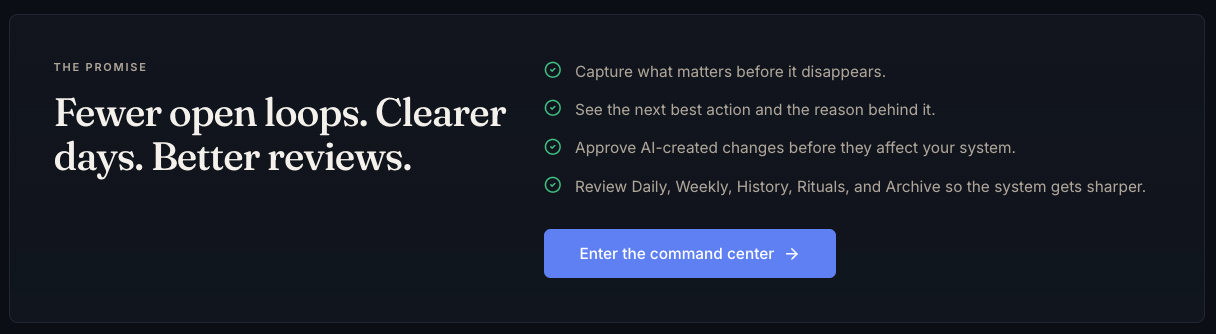
Capture what matters.
Connect it to a mission or project.
Choose what deserves attention.
Execute from the daily command center.
Review what happened.
Update the system.
Repeat.
That sounds obvious. Good systems often do.
The difficulty is maintaining the loop when work becomes noisy. Most people capture more than they review. They plan more than they update. They complete tasks without reconsidering the project, and they reconsider projects without revisiting the mission.
The feedback loop breaks.
Apex makes Review a first-class part of the product rather than an empty page reserved for Sunday evening discipline.
Daily Review shows momentum, completed work, unfinished obligations, focus time, rituals, and journal entries.
Weekly Review helps examine mission progress, shipped work, relationships, metrics, and the shape of the coming week.
History creates a record of movement over time.
Rituals track the practices that support the system.
Archive preserves completed work without letting it crowd the present.
Execution produces data. Review turns that data into judgment. Judgment changes the next plan.
That is how a system learns.
Who Apex Is For
Apex is for people carrying several forms of responsibility at once.
Founders building companies while managing health, capital, family, and relationships.
Solo operators who are simultaneously strategist, manager, analyst, and executor.
Builders whose work crosses projects, disciplines, and time horizons.
People with enough ambition that a flat task list has stopped being an adequate model of their lives.
These users do not need more notifications. They need coherence.
They need to see the relationship between today’s work and the system they are trying to build over years.
They need somewhere to think, decide, act, and review.
Wealth Is a Systems Outcome
Apex belongs inside Wealth Systems because wealth is not an account balance.
Wealth is accumulated capacity.
Financial capital matters. So do health, knowledge, time, agency, relationships, reputation, and the ability to turn decisions into sustained action.
These forms of capital interact.
Poor health weakens execution. Weak relationships reduce opportunity. Fragmented attention lowers the return on knowledge. A strong mission can organize effort, but only if the daily system keeps it alive.
The quality of your outcomes depends on the quality of the system connecting them.
That is the central idea behind Apex.
Your life’s work is not a collection of unrelated tasks. It is a portfolio of connected systems competing for finite resources.
Run it like an organized system. Use AI to add leverage to that system.
Apex Is Live
Apex is now live! We are in beta, getting feedback from both Free and Pro users.
The first Pro customer already executed her first Apex daily loop. She’s an author and a consulting business owner. She loves the product and uses it each morning and night.
A live product is never a finished product. It’s a system that has begun receiving valuable feedback from reality. There is plenty left to improve. There always is. I’ve built a long, prioritized list of feature improvements and new features to add. Working on them as you read this!
That feedback will shape what Apex becomes next.
But the core idea is here now.
The productivity era gave us better places to store our work.
The AI era can give us better systems for directing it.
Apex is my attempt to build that system.
You can explore it at apex.wealthsystems.ai.
Also, paid members of Wealth Systems will be receiving a free month on Apex as soon as we exit the beta. We’re going to do a world premier / grand launch when Apex in the Fall!
First of several Wealth Systems we are launching.
Let me know what you think!
👋 Thank you for reading Wealth Systems. I started Wealth Systems in 2023 to share the systems, technology, and mindsets that I encountered on Wall Street. I am a Wall St banker became ₿itcoin nerd, data engineer, agentic engineer & family office investor.
…or you can find me on LNKD.
💡The BIG IDEA is share practical knowledge so we can each build and optimize our own wealth engines and combine them into a wealth system.
To help continue our growth please Like, Comment and Share this.
Disclaimer: For Informational Purposes Only
The content provided on this blog is for informational and educational purposes only and does not constitute financial, accounting, or legal advice. The author is not a licensed financial advisor, broker/dealer, or regulated by any financial authority.
No Warranties: All information is provided “as is” without any representations or warranties, express or implied. While every effort is taken to ensure the accuracy of the information, the author and blog owner cannot guarantee that the information is accurate, complete, or current. The author is not liable for any errors, omissions, or delays in this information or any losses, injuries, or damages arising from its display or use.
Investment Risks: Any investments, trades, or financial decisions made based on information found on this site are done at your own risk. Past performance is not indicative of future results. Investing involves a high level of risk, and you should perform your own due diligence before making any investment decisions.
Consult a Professional: Please consult with a certified financial advisor, accountant, or legal professional before making any financial decisions. By using this website, you agree to hold the author and blog owner harmless from any liability resulting from your use of this information.
Affiliate Disclosure: Some links on this website are affiliate links. This means if you click on the link and purchase the item or sign up for a service, I may receive a small commission at no extra cost to you. I only recommend products or services I personally use or believe will add value to my readers.