

Most people still think power is political.
They are wrong.
Politics is downstream.
Policy is downstream.
Diplomacy is downstream.
Markets are downstream.
The root layer is physical.
That was the core argument of The Physics of Power: you cannot understand global strategy by watching speeches, elections, summits, or television panels. Those are surface signals. They are derivatives. The real system is built beneath them.
Energy is the base layer. Energy feeds production.
Production feeds capital.
Capital feeds force.
Force protects the system.
The entire global order is not floating in an abstract cloud of treaties and good intentions. It is moving through pipes, ports, tankers, canals, cables, rail lines, refineries, terminals, and narrow bodies of water that most people cannot find on a map.
That is why energy is not a commodity.
Energy is sovereignty.
Energy Is Everything
Oil is not just fuel.
Oil is optionality.
Natural gas is not just heat.
Natural gas is industrial continuity.
Electricity is not just power.
Electricity is civilization expressed as voltage.
And every civilization has a weakness.
Every empire has an intake valve.
Every industrial machine has a throat.
Find the throat.
You find the leverage.
This is the chokepoint map.
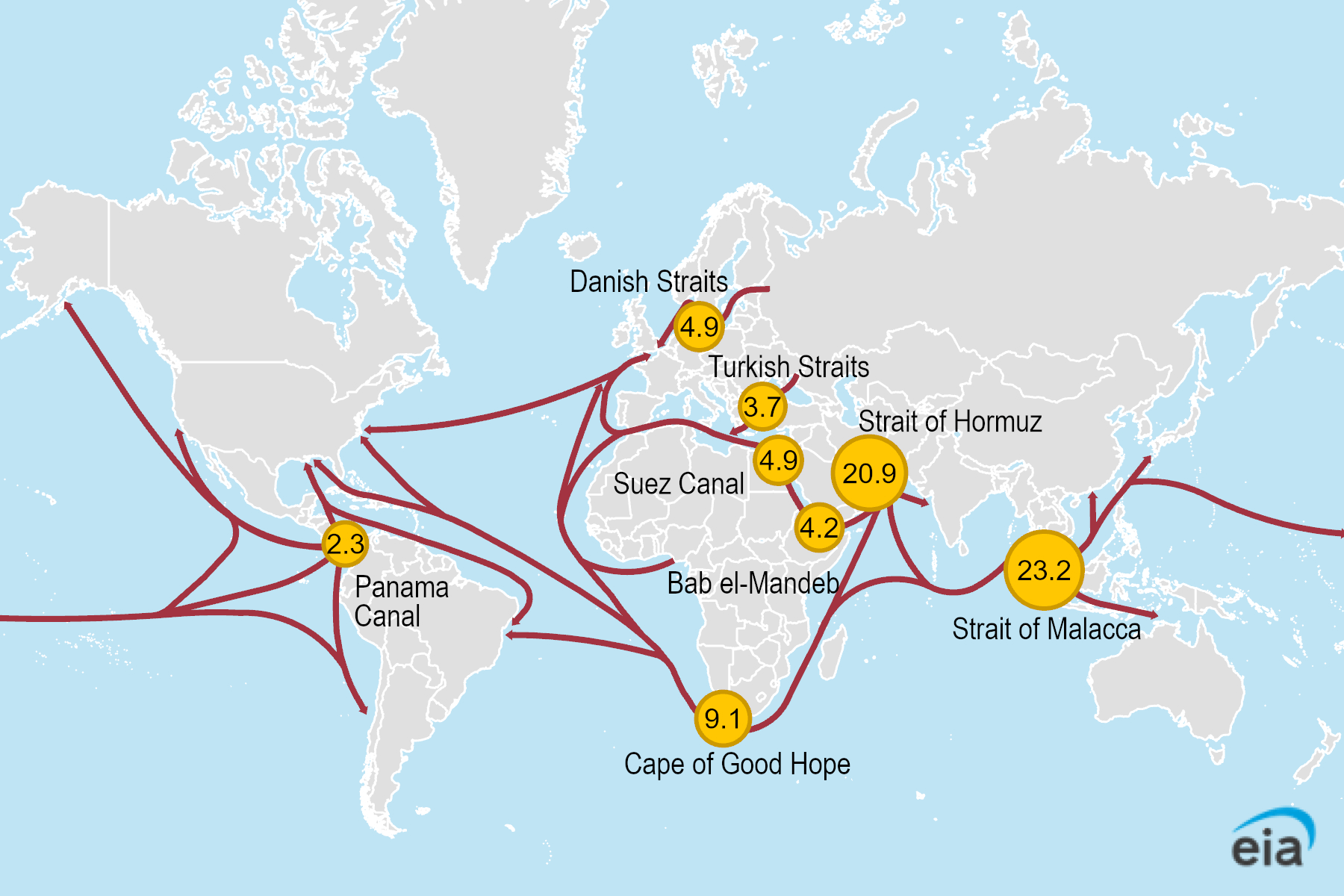
The world is not flat.
The world is not open.
The world is not a frictionless marketplace where ships glide peacefully across neutral oceans because some economist in a seminar room said trade creates mutual benefit.
The world is a battlefield of constrained routes.
There are only so many ways to move the fuel.
There are only so many ways to move the grain.
There are only so many ways to move the chips, the machines, the rare earths, the containers, the fertilizer, the diesel, the LNG, the weapons, and the capital goods that keep modernity alive.
The map is not defined by landmass.
The map is defined by compression.
Where does the flow compress?
Where does the ocean narrow?
Where does a continent force trade into a canal?
Where does geography turn a global supply chain into a single file line?
That is where power lives.
Not in the press conference.
Not in the communique.
Not in the slogan.
In the bottleneck.
The first node is Malacca.
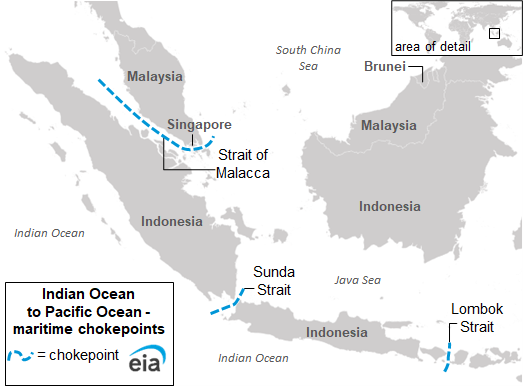
You cannot understand China without understanding Malacca.
China is not merely a country. China is a machine. A vast industrial engine. A manufacturing stack optimized across decades to convert imported energy, imported raw materials, and domestic human capital into exportable goods at planetary scale.
But every machine has an input problem.
The Chinese engine demands fuel.
It demands oil.
It demands gas.
It demands iron ore.
It demands food.
It demands uninterrupted maritime flow.
And the primary corridor for that flow is the Strait of Malacca.
This is the narrow passage between Malaysia, Indonesia, and Singapore. It links the Indian Ocean to the South China Sea. It is one of the most important commercial arteries on Earth. The U.S. Energy Information Administration estimated that the Strait of Malacca handled 23.2 million barrels per day of oil flow in the first half of 2025, making it the largest oil transit chokepoint in the world by volume.
Read that again.
The largest.
Not a regional detail.
Not a shipping trivia question.
A planetary artery.
For China, Malacca is not just a route. It is a dependency. It is the logistical umbilical cord connecting Middle Eastern energy, African commodities, and European trade routes to the Chinese industrial base.
This is the Malacca Dilemma.
It is not theoretical.
It is not academic.
It is structural.
China can build aircraft carriers. China can build missiles. China can build artificial islands. China can build ports across the Belt and Road. China can sign long-term energy agreements. China can stack strategic reserves. China can build pipelines from Russia, Kazakhstan, and Myanmar.
All of that matters.
None of it solves the core problem.
The Chinese industrial system still depends on maritime corridors it does not fully control.
That is fragility.
That is leverage.
That is the map.
People obsess over Taiwan because Taiwan is visible. Taiwan is dramatic. Taiwan gives the media a simple board: ships, jets, missiles, beaches, invasion scenarios, red arrows, blue arrows, television graphics.
But Taiwan is not the opening move.
Taiwan is the prize.
The opening move is fuel.
A military campaign against Taiwan would require enormous energy continuity. It would require fuel for ships, aircraft, logistics, domestic industry, emergency production, and internal stability. A state does not launch a high-intensity conflict while wondering whether its factories, refineries, ports, and cities can keep running.
That is why the leading indicator is not the amphibious landing craft.
The leading indicator is energy access.
Watch the insurance markets. Watch tanker rates.
Watch naval deployments. Watch the ports.
The war is not only fought where the flag is planted.
The war is fought where the fuel moves.
The second node is Hormuz.
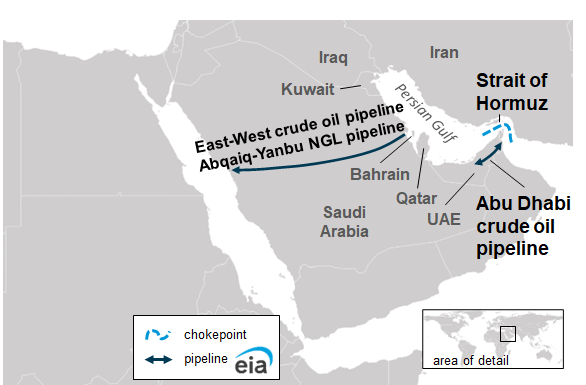
Hormuz is the gate of the Persian Gulf.
It sits between Iran and Oman. It connects the Persian Gulf to the Gulf of Oman and the Arabian Sea. It is a narrow maritime valve through which a staggering volume of energy moves. The EIA reported that oil flow through Hormuz averaged about 20 million barrels per day in 2024, roughly one-fifth of global petroleum liquids consumption.
This is why Iran matters.
This is why the Gulf matters.
This is why every serious empire watches Hormuz.
Because Hormuz is not simply a regional waterway. It is a pricing mechanism for the world.
If Hormuz tightens, prices move.
If Hormuz destabilizes, insurance moves.
If insurance moves, shipping costs move.
If shipping costs move, inflation moves.
If inflation moves, central banks move.
If central banks move, asset prices move.
This is the chain. The public sees a headline about tension in the Gulf.
The operator sees a global margin call.
Hormuz is also where the Asian dependency becomes obvious. The EIA estimated that in 2024, 84% of the crude oil and condensate moving through Hormuz went to Asian markets. China, India, Japan, and South Korea were the major destinations.
That means Hormuz is not just a Middle East issue.
It is an Asian industrial issue.
It is a Chinese import issue.
It is a Japanese energy security issue.
It is a Korean manufacturing issue.
It is an inflation issue for every country plugged into the global energy system.
This is why the United States has spent decades protecting sea lanes while commentators complained about endless foreign entanglements. They missed the architecture. The U.S. Navy was not merely patrolling water. It was underwriting global commerce. It was guaranteeing the operating system.
The oceans are not free. The oceans are secured.
There is a difference. Freedom of navigation is not a phrase. It is an enforcement regime.
The third node is Bab el-Mandeb.
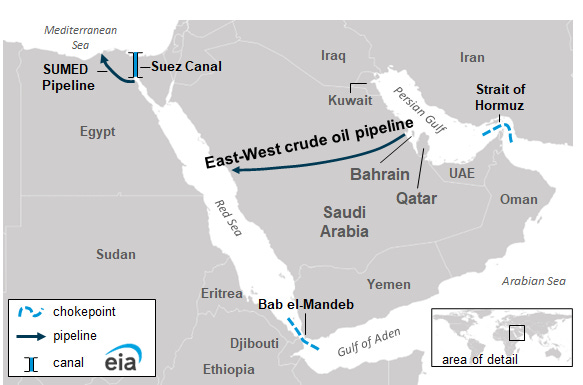
Most people ignored it until the ships started rerouting.
Then the market remembered.
Bab el-Mandeb is the narrow strait between Yemen and the Horn of Africa. It connects the Red Sea to the Gulf of Aden. It is the southern gate to the Suez system. If Suez is the commercial shortcut between Asia and Europe, Bab el-Mandeb is the lock on the door.
Disrupt Bab el-Mandeb and the system does not stop.
It stretches.
Ships reroute around the Cape of Good Hope.
Distance increases. Fuel burn increases. Crew time increases. Insurance premiums increase.
Working capital gets trapped on the water.
Inventory arrives late.
Margins compress.
This is how friction enters the machine.
Not through ideology.
Through distance.
The modern economy was built on the assumption that distance could be compressed by logistics. Containerization, just-in-time inventory, cheap bunker fuel, global routing software, port automation, and maritime insurance created the illusion that geography had been conquered.
It had not been conquered.
It had been temporarily abstracted.
Then the abstraction broke.
The Red Sea disruptions exposed the lie. UNCTAD reported that pressure on the Red Sea, Suez, and Panama routes forced costly rerouting around Africa. By mid-2024, Suez Canal tonnage was down sharply, while arrivals around the Cape of Good Hope surged.
That is what a chokepoint does.
It reveals the hidden cost of fragility.
The fourth node is Suez.
Suez is not just a canal.
It is a time machine.
It takes the long route around Africa and collapses it into a narrow artificial passage through Egypt. It connects the Mediterranean to the Red Sea. It links Europe and Asia. It is one of the great engineered shortcuts of civilization.
But every shortcut creates dependency. The more efficient the route, the more devastating the interruption.
Efficiency breeds fragility when redundancy is removed.
That is the core error of the globalist supply chain model. It optimized for cost in a world it assumed would remain politically stable, militarily protected, climatically predictable, and financially liquid.
Those assumptions are dying.
Suez is a perfect symbol of the old model.
A narrow passage carrying massive trade volume, dependent on regional stability, insurance confidence, naval deterrence, and operational competence.
One ship can block it. One conflict can reroute it.
One insurance repricing can change the economics.
One geopolitical actor with cheap drones can impose costs on a trillion-dollar trade system.
This is asymmetry.
The attacker does not need to destroy the system.
He only needs to add friction.
Friction does the rest.
The fifth node is Panama.
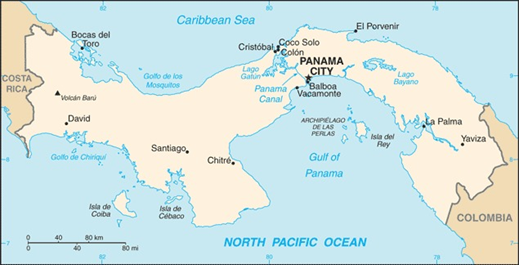
Panama is different. Panama shows you that not every chokepoint is controlled by missiles.
Some are controlled by water. The Panama Canal connects the Atlantic and Pacific. It is critical for trade between Asia and the U.S. East Coast, and between the Americas. But the canal depends on freshwater. Ships do not simply pass through a ditch. They are lifted and lowered through locks that require water from the surrounding lake system.
When drought hits, capacity tightens.
Draft restrictions appear.
Transit slots shrink.
Ships wait.
Cargo reroutes.
Costs rise.
This is the part most geopolitical analysts miss.
Nature is also a power.
Hydrology is also strategy. Rainfall is also infrastructure.
You can have treaties, markets, allies, and ships. But if the water level falls, the canal constricts. The system obeys physics before it obeys politics.
That is the deeper lesson.
The chokepoint map is not only about war.
It’s about constraint across many dimensions:
Military constraint
Energy constraint
Insurance constraint
Climate constraint
Port constraint
Balance sheet constraint
Every constraint is an opportunity for whoever sees it first.
The sixth node is the Cape of Good Hope.
The Cape is not a chokepoint in the same way Malacca or Hormuz is a chokepoint. It’s the global fallback route. It is the release valve. It is what the system uses when the shortcut becomes too risky.
But fallback routes have costs.
Going around the Cape adds time, fuel, distance, and uncertainty. It changes vessel availability. It absorbs capacity. It delays cargo. It alters trade flows. It benefits some ports and punishes others. It rewards players with inventory buffers and destroys players running fragile just-in-time models.
If you see this table rising relative to the other nodes, it’s costly for the global economy in more ways than one.
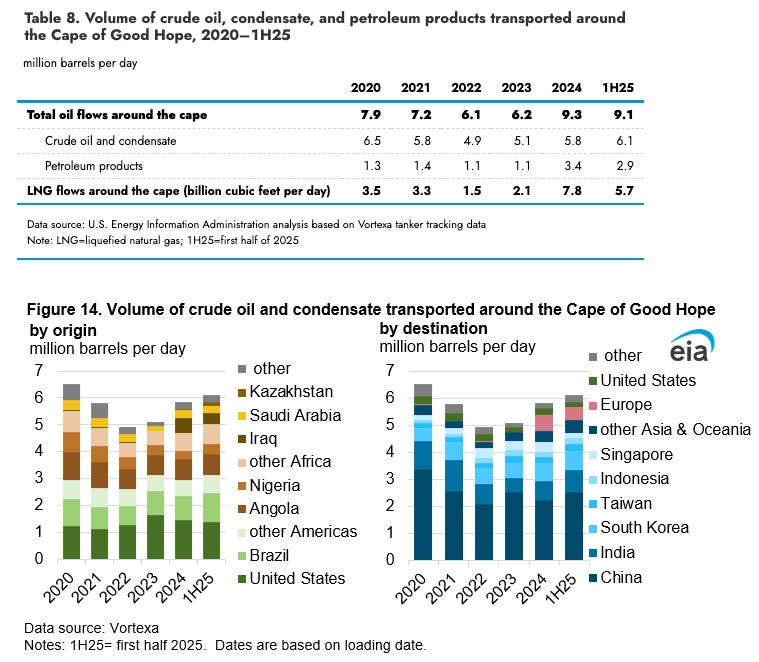
This is where macro becomes operational.
A shipping delay is not just a shipping delay.
It is a working capital event.
It is an inventory event.
It is a pricing event.
It is a credit event.
It is a political event.
The consumer sees a higher price.
The operator sees the route map.
The investor sees the margin pressure.
The state sees the strategic exposure.
This is why you must stop reading headlines as isolated events.
Nothing is isolated.
Malacca connects to China. Hormuz connects to Asia. Bab el-Mandeb connects to Suez. Suez connects to Europe. Panama connects to U.S. trade. The Cape connects to fallback capacity.
Insurance connects all of it.
Naval power connects all of it.
Energy connects all of it.
The map is alive.
The mistake is thinking power is held by whoever owns the most land.
No.
Power belongs to the nations with excess energy, and that is controlled by whoever can keep their flows open while constricting the flows of others.
That is the game.
America understands this better than anyone because America is not merely a continental power. America is an oceanic power with continental depth. It has farmland, shale basins, refineries, ports on two oceans, inland waterways, pipeline networks, rail, air power, naval reach, financial markets, reserve currency depth, and the ability to project force across the system.
That combination is rare.
It is not an accident.
This is the architecture of dominance.
China has industrial scale but maritime vulnerability.
Europe has legacy wealth but energy dependency and innovation scarcity.
Japan has technology but import dependency with China at their doorstep, literally.
The Middle East has energy but export dependency and an under-developed middle class of consumers and creators.
Russia has resources but route constraints and global reputation issues.
America has optionality.
Optionality is power.
This is why energy dominance matters.
This is why domestic production matters.
This is why refining capacity matters.
This is why LNG export terminals matter.
This is why shipyards matter.
This is why ports matter.
This is why naval readiness matters.
This is why the grid matters.
Because the next chokepoint layer is not only oil.
It’s power.
Compute is the new oil, but compute still plugs into the wall.
AI does not run on vibes.
Data centers do not run on policy papers.
Semiconductors do not fabricate themselves in an energy vacuum.
The new industrial stack will be constrained by electricity, cooling, transformers, gas turbines, nuclear capacity, transmission lines, rare earths, chip tools, and secure logistics.
The chokepoint map is expanding.
It is moving from sea lanes to substations.
From canals to data centers.
From tankers to transformers.
From oil routes to power markets.
But the rule stays the same as they always were:
Find the constraint.
Find the leverage.
Find the throat.
The global system is being reorganized around this truth.
The weak will keep watching speeches.
The strong will watch flows. They will watch barrels per day. They will watch vessel traffic. They will watch insurance spreads. They will watch port congestion. They will watch electricity demand. They will watch LNG contracts. They will watch refinery utilization.
They will watch who builds redundancy and who prays for stability.
Stability is not a strategy.
Redundancy is a strategy. Control is a strategy. Production is a strategy.
Energy is a the ultimate goal.
Watch Malacca.
Watch Hormuz.
Watch Bab el-Mandeb.
Watch Suez.
Watch Panama.
Watch the Cape.
Watch the grid.
The board is not hidden. Most people simply do not know how to read it.
Now, you know how to read it.
Read the map.
Track the flow.
Use that information to power your wealth systems.
👋 Thank you for reading Wealth Systems. I started Wealth Systems in 2023 to share the systems, technology, and mindsets that I encountered on Wall Street. I am a Wall St banker became ₿itcoin nerd, data engineer, agentic engineer & family office investor.
…or you can find me on LNKD.
💡The BIG IDEA is share practical knowledge so we can each build and optimize our own wealth engines and combine them into a wealth system.
To help continue our growth please Like, Comment and Share this.
Disclaimer: For Informational Purposes Only
The content provided on this blog is for informational and educational purposes only and does not constitute financial, accounting, or legal advice. The author is not a licensed financial advisor, broker/dealer, or regulated by any financial authority.
No Warranties: All information is provided “as is” without any representations or warranties, express or implied. While every effort is taken to ensure the accuracy of the information, the author and blog owner cannot guarantee that the information is accurate, complete, or current. The author is not liable for any errors, omissions, or delays in this information or any losses, injuries, or damages arising from its display or use.
Investment Risks: Any investments, trades, or financial decisions made based on information found on this site are done at your own risk. Past performance is not indicative of future results. Investing involves a high level of risk, and you should perform your own due diligence before making any investment decisions.
Consult a Professional: Please consult with a certified financial advisor, accountant, or legal professional before making any financial decisions. By using this website, you agree to hold the author and blog owner harmless from any liability resulting from your use of this information.
Affiliate Disclosure: Some links on this website are affiliate links. This means if you click on the link and purchase the item or sign up for a service, I may receive a small commission at no extra cost to you. I only recommend products or services I personally use or believe will add value to my readers.