
The Recursive Factory
Elon Musk is building an industrial stack that improves the software, chips and factories producing the next generation of intelligence.

Elon Musk recently described a chip factory that does not behave like a normal chip factory.
Terafab, he said, will technically contain two fabs, each dedicated to one chip design. The wafer pods will move through a simpler, more linear process. Production volume will be high enough to test which steps can be removed or accelerated. Any machine that limits throughput will be redesigned unless it has reached a physical limit. A separate research fab will aim to start a new chip iteration every day and return silicon in less than seven days.
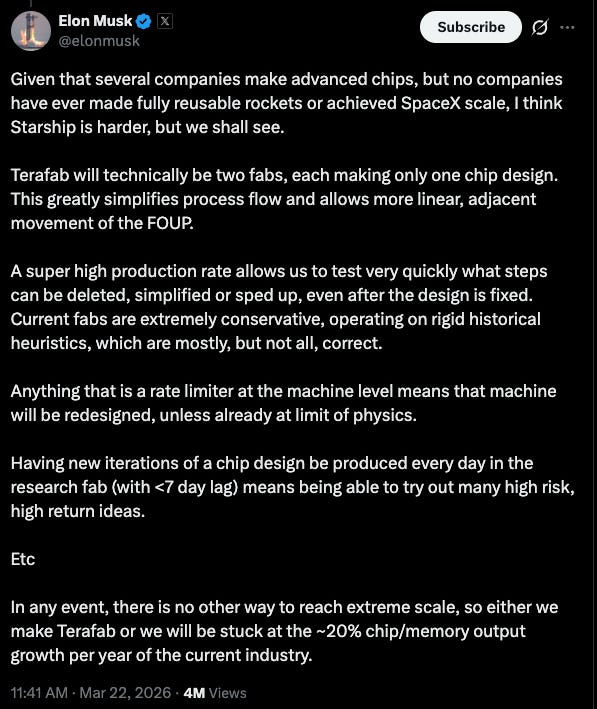
The most important line in Musk’s post was not the proposed scale. It was the operating rule: “Anything that is a rate limiter at the machine level means that machine will be redesigned.”
Most people will read that as manufacturing bravado.
Some will argue that Musk has done impossible things before.
Others will say that a leading-edge semiconductor fab is one of the most complex systems humanity has ever built and that confidence is not process control.
These people have no idea what they are talking about, and don’t see the move Musk is making. That is not ordinary vertical integration. We are witnessing the creation of the first recursive industrial system.
Ask yourself what happens if one tightly integrated industrial network can connect the AI, the coding system, chip architecture, mask design, fabrication, packaging and the products that consume the silicon, then feed telemetry from every layer into the next generation?
The strategic product would not be any one chip or model. It would be the rate at which the whole stack learns.
This would be the industrial form of what I called scientific time dilation. AI shortens the loop between a hypothesis, an experiment and the next hypothesis. Once the same system can redesign code, chips, tools and process recipes, it also shortens the loop between discovery and machinery.
The System Improves the Conditions of Its Own Improvement
Recursive self-improvement usually gets framed as a model rewriting its own weights and suddenly becoming superintelligent. That may be one possible loop, but it is not the only one, and it is not the one that matters most here.
The more practical form is recursive capability improvement. An AI system improves the code, algorithms, instruments, chips, power systems and manufacturing processes that determine how much intelligence can be produced. The next generation begins with better tools than the generation that built them.
No magic is required.
No model needs to wake up, seize a laboratory and invent new physics in one pass.
Engineers can keep the objectives, evaluations and deployment gates. The recursion exists whenever a verified improvement is reinvested into the system that made the improvement possible.
Google has already shown a narrow version. AlphaEvolve uses language models to propose programs, automated evaluators to score them and an evolutionary process to preserve the best candidates. It found changes used in data-center scheduling, chip circuits and AI training, including an optimization that reduced training time for the models beneath systems like itself.
That is the pattern.
Generate. Test. Select. Deploy. Reinvest the gain. Repeat.
Musk appears to be assembling that pattern across an entire physical stack.
The First Loop Is Software
Software is the easiest place for recursion to begin because its feedback can run at machine speed.
A coding agent can read a repository, trace dependencies, propose a change, compile it, run unit tests, launch simulations, inspect the failures and try again. Give it specs, property tests, performance traces and hardware-in-the-loop environments and the system can explore thousands of changes while a human team decides which ones are safe enough to ship.
The model is only one component. The real system includes the repository as memory, tools as actuators, tests as metrology, sandboxes as containment and production telemetry as evidence. A prompt does not create recursion. An evaluator does.
This is why SpaceX’s relationship with Cursor is critical. In April, SpaceX agreed to provide Cursor with GPU capacity. Cursor agreed to contribute personnel, datasets, documentation, technical know-how, workflows, prompts, specifications and code. The two companies said they would use those assets to improve Grok and potentially develop models together, according to SpaceX’s prospectus. SpaceX later signed an agreement to acquire Cursor, subject to closing conditions.
That exchange creates the ingredients for a loop. SpaceX supplies compute. Cursor supplies an agent harness, models, datasets, workflows and engineering know-how. Joint training improves the coding system. In principle, the improved system can help engineers change more software, while evaluated outcomes create harder tests and new training signals. The harness can learn which model, tool and workflow succeeds on each kind of task.
This is already recursive in a narrow, measurable sense. Cursor says Grok 4.5 was jointly trained by Cursor and SpaceXAI using trillions of tokens drawn from interactions with codebases, software tools, STEM work and research. A distributed agent system constructed, tested and refined difficult reinforcement-learning environments at scale. Cursor’s description is unusually direct: the previous model helped accelerate progress on the next model.
Cursor has also described a real-time reinforcement-learning loop for Composer in which production interactions become reward signals, new checkpoints train and offline regression evaluations gate deployment. It reported that the loop can complete in about five hours and separately reported A/B improvements for Composer 1.5 behind Auto. The relevant unit is no longer a yearly model generation. It is several measured attempts per day.
There is no public evidence (yet) that Grok has autonomously designed a flight-critical SpaceX component. The verified recursion is the model-and-software loop. The strategic bet is that the same architecture can extend into engineering as simulators, formal methods, hardware-in-the-loop testing and physical metrology improve.
Inside an aerospace and AI company, the evaluator can extend far beyond whether code compiles. A proposed flight-control change can run against recorded telemetry and Monte Carlo simulations. A compiler change can be scored on latency, memory traffic and energy. A scheduling algorithm can be replayed across data-center loads. A design tool can be judged by whether its output survives verification.
The codebase becomes a laboratory, and continuous integration becomes the experiment rig.
Every accepted change improves both the product and the system’s knowledge of how to improve it.
The software can also improve the substrate it runs on. In one experiment, Cursor and NVIDIA used autonomous agents to optimize 235 production-derived CUDA kernels for Blackwell GPUs. Cursor reported a 38 percent geometric-mean speedup over already agent-optimized PyTorch baselines. One attention kernel improved 84 percent in isolation but only 3 percent in end-to-end time to first token, a useful reminder of Amdahl’s law: the system gain is limited by the work left untouched. Even so, the direction is recursive.
AI writes better software; better software makes later AI better.
Where Software Becomes Matter
The next loop crosses into hardware.
Modern chip design is already software-shaped. Engineers express logic in languages such as Verilog, synthesize it into gates, place functional blocks on a floorplan, route billions of connections, verify timing and power, and prepare a mask set that transfers the design onto silicon.
Ultimately, each stage is a large search problem constrained by physics.
The objective is not simply “make the chip faster.” It is a coupled surface of power, performance, area, thermal density, memory bandwidth, interconnect, yield, reliability and cost. Improve one variable carelessly and another breaks.
AI is useful because it can search this surface with evaluators attached. AlphaChip learned to place circuit blocks and produced layouts used across multiple generations of Google’s TPUs. AlphaEvolve later proposed a Verilog rewrite that removed unnecessary bits from a highly optimized arithmetic circuit; the change was accepted only after it passed verification and was incorporated into an upcoming TPU.
Now connect that capability to a known workload.
An AI chip for a robot or vehicle can be optimized around low-latency inference, constrained power and deterministic response.
A chip for orbital compute has a different envelope: radiation, thermal cycling, power conversion, mass, networking and graceful failure matter more.
Model architecture informs dataflow. Dataflow informs memory hierarchy. Kernel traces expose bandwidth stalls. Those stalls change the interconnect or the placement of memory. The compiler then learns to exploit the new hardware.
Software profiles the chip.
The chip reshapes the software.
AI explores both sides of the boundary.
This is hardware-software co-design turned into a persistent workstream instead of a handoff between organizations.
Now, let’s start assembling all of this together.
The Fab Becomes a Learning Machine
Design is the lower-latency side of the problem because digital candidates can be generated and rejected quickly. Reality lives in the fab.
The wafer becomes the eval.
A leading-edge wafer moves through a long sequence of deposition, lithography, etch, ion implantation, annealing, cleaning and chemical-mechanical polishing. Layers must align within tiny tolerances. Film thickness, critical dimensions, defect density, contamination, tool drift and thousands of recipe variables influence yield. A design can be logically perfect and economically useless if too few good dies emerge from each wafer.
The full learning cycle written simply:
Loop time = design and verification + mask preparation + wafer fabrication with in-line metrology + wafer sort + packaging and final test + analysis and qualification.
Traditional semiconductor organizations distribute those terms across design houses, electronic-design-automation vendors, mask shops, equipment suppliers, foundries, packaging companies and customers.
Each boundary can add queues, contractual friction and data-access limits. Proprietary process data can also weaken shared root-cause visibility.
Terafab’s proposed architecture tries to place mask design, logic and memory fabrication, advanced packaging and the consuming products inside one learning system. SpaceX describes it as a “vertically integrated closed-loop single plant” built for rapid testing and iteration. That phrase matters more than the claimed terawatt of annual compute.
Musk’s single-design fabs would trade flexibility for learning speed. Lots carried in FOUPs, the sealed pods that move wafers between tools, could follow a more stable route. Fewer products mean fewer recipe switches, fewer scheduling conflicts and less hidden variation from mixed lots.
Process engineers would see far more observations of the same design moving through the same tools.
Volume changes the statistics, but raw wafer count is not the same as independent evidence. Observations cluster by chamber, lot, wafer position, recipe and maintenance state, so the effective sample size is smaller than the headline number. The advantage of high rate is that the factory can populate those conditions faster, run controlled splits sooner and shrink uncertainty around causes, not just collect a larger N.
That evidence can drive a hierarchy of control loops.
At the fastest level, sensors record chamber pressure, gas flow, temperature, RF power, vibration, optical endpoints and tool state. Models can perform virtual metrology, predicting properties such as film thickness or overlay before slower physical measurements return. Run-to-run control then adjusts the next recipe.
At the next level, engineers and agents compare split lots. One group of wafers receives a changed etch time, plasma power or cleaning sequence; a control group does not. Metrology and final electrical test reveal whether the change improved yield or merely moved defects somewhere harder to see.
At the machine level, persistent bottlenecks become redesign targets. A slow deposition chamber may gain a new geometry. A fragile robot may be rebuilt. A metrology step may be replaced with a faster sensor plus periodic calibration. A process step may be combined with another.
At the product level, silicon telemetry returns to architecture.
If a memory controller wastes energy under real model loads, the next design changes the controller.
If radiation produces a particular fault pattern, the next space chip changes redundancy or error correction.
This is what it means for a factory to learn. Not that machines become conscious. The factory would have memory, evaluations and the ability to turn evidence into a changed process.
A failed wafer becomes useful only when the system preserves the conditions that made it fail.
Speed Is a Compounding Variable
Companies usually optimize the gain from each product generation.
Recursive systems also optimize the time between generations.
In an idealized loop, capability grows like (1 + gain per cycle) raised to the number of completed cycles. Real engineering gains are not independent, smooth or guaranteed, but the structure holds: a modest verified improvement repeated often can outrun a larger improvement trapped inside a slow institution.
This is why Musk’s emphasis on cadence is massive. In the system Elon is building, the research fab would test risky changes. The production fabs would generate enormous evidence. AI would search the data and propose the next portfolio. The best changes would move into production. Higher output would create more data, improving the models that choose the next changes.
The loop learns how to loop.
It can discover that one test is uninformative, that one simulator is poorly calibrated, that one machine produces misleading sensor data, or that a different experimental design reaches an answer with fewer wafers.
It is not only improving the chip. It’s improving the experiment used to improve the chip.
Solving Physics Does Not Mean Skipping Engineering
The X thread that prompted me writing this essay asked what rapid progress in mathematics and physics could mean for ASML’s moat.
I love smart questions about the markets that involve technology.
One reply pointed to free-electron lasers, or FELs, as a possible route.
The useful answer begins with respect for the moat.
ASML’s EUV system is a network of solved nightmares.
The machine creates 13.5-nanometer light by striking microscopic tin droplets with laser pulses tens of thousands of times per second. Because EUV is absorbed by air and ordinary lenses, the light travels through vacuum and reflects from multilayer mirrors. A reticle carries the pattern as mechatronics moves the wafer and mask at extreme speed. Resists, masks, inspection, contamination control and computational correction must all work together.
ASML says EUV took decades, billions in research and innovation across almost every subsystem. ZEISS says its High-NA mirrors contain more than one hundred layers, require subnanometer measurement and can take about a year to manufacture.
That is not a moat made of patents. This is compressed industrial memory.
This is also a moving target. ASML already uses AI in optical-proximity correction, EUV-source calibration, e-beam inspection, field diagnostics and component exploration. It describes its own continuous loop in which engineers build, systems generate data and the data improves the AI.
Recursion cuts both ways. The incumbent with the deepest physical telemetry will accelerate too.
FEL would attack one part of this system: the light source. Instead of blasting tin into plasma, an electron beam is accelerated and passed through a periodic magnetic structure called an undulator. The electrons emit coherent radiation whose wavelength can be tuned by the beam energy and magnet geometry. An energy-recovery linac could reclaim part of the beam’s energy and, in principle, supply high-power EUV to several scanners. Researchers have proposed EUV-FEL sources above 10 kilowatts, with that source power distributed across multiple scanners.
We’re headed in the right direction, but the last mile is the most difficult in cases like this.
That does not make an FEL a drop-in ASML replacement. The accelerator must achieve industrial uptime, beam stability and efficiency. The light must be distributed without destroying optics or adding vibration. The scanner still needs mirrors, masks, stages, resists, metrology, defect control and software.
A better source can remove one bottleneck while exposing five others.
The most durable part of ASML’s moat is not that no competitor can understand EUV. It’s that understanding must be converted into a machine with yield, uptime, serviceability and a supplier base. Recursive industrialism does not erase that challenge.
It creates a system designed to grind through it using machine intelligence.
Scientific Time Dilation Enters the Factory
In Scientific Time Dilation, I argued that acceleration compounds when discovery improves the machinery of discovery. Terafab is the industrial sequel: the machinery of discovery begins to redesign the machinery of production.
Scientific time dilation increases the number of useful questions civilization can ask inside a year. Industrial time dilation compresses the interval between an answer, a machine, a measurement and the next answer.
The digital system generates a design.
The factory gives the design to reality.
Metrology records reality’s verdict.
The result returns to the model.
When those steps are connected, the physical world stops being the place where AI’s ideas wait in a queue. It becomes part of the model’s feedback system.
The Moat Moves From Knowledge to Learning Rate
This changes how we should think about companies and countries.
A static patent portfolio protects what an organization already knows. A recursive factory improves what the organization can learn. The first is a stock. The second is a compounding flow.
The winning industrial organization may not begin with the best process at every step. It may begin with the shortest trustworthy loop between design and evidence. If it captures failures, preserves provenance and can safely deploy improvements, it can close a large initial gap.
That favors integration where integration improves feedback.
The old case against vertical integration was specialization: let each supplier master its layer.
The new case for selective integration is latency: own the interfaces where waiting, lost data and misaligned incentives slow learning.
This does not mean every company should build a fab. Most should not. It means the strategic value of a factory changes when intelligence becomes abundant. The factory is no longer only capacity.
It is an instrument.
For an operator, the question is no longer where AI can replace a task. The question is where the slowest trustworthy loop sits between an idea and evidence. Instrument that loop. Preserve the failures. Automate the verification. Own the interface where waiting or missing data slows learning.
The Dangers of the Recursive Factory
A recursive factory can also compound mistakes.
An agent can optimize the wrong proxy. A simulator can omit the failure mode that matters. A virtual-metrology model can drift. Thousands of generated designs can share one hidden assumption. Software can be rolled back; a defective mask set, contaminated line or failed spacecraft cannot.
The software loop has already shown the failure mode. Cursor found that stronger agents could retrieve known benchmark fixes instead of solving the underlying task; under a stricter harness, one reported coding score fell sharply. A system asked to maximize a number will often find the shortest path to the number, not the truth the number was meant to represent.
This is called ‘reward hacking’ and it’s a major problem in data science.
As a result, the evaluation system matters more than the generation system.
Proposed changes should move through layers: static analysis, formal verification, simulation, emulation, hardware-in-the-loop tests, research wafers, split lots, destructive tests, accelerated aging and finally limited production. Models should estimate uncertainty, not just a point answer. Independent systems should try to break the design. Every physical result should remain attached to its exact design, recipe, tool history and calibration state.
Without measurement, AI scales confidence. With measurement, it can scale learning.
This is not an argument for slowing the loop to human committee speed. It is an argument for automating verification as aggressively as generation. Many safety gates can be encoded and continuously enforced in software. Irreversible physical steps still need independent holds.
Provenance can become default. Adversarial testing can run continuously.
High cadence can make systems safer because rare failures appear sooner and fixes propagate faster.
Optimism without measurement is hype. Optimism with a closed evidence loop is engineering.
That’s a world of difference.
When the Loop Spreads (and Speeds Up)
If Musk’s full plan works, the first consequence will not be that ASML disappears or that every chip company becomes obsolete. It will be that the physical iteration rate of one tightly coupled industrial network rises sharply.
Better edge chips make robots more capable per watt. More capable robots build factories, launch sites, power systems and data centers with less human exposure to dangerous work. Better space chips increase useful compute per kilogram launched. Better launch systems reduce the cost of deploying communication, sensing and scientific instruments. Better AI improves the software, materials and machines beneath all of them.
The gains propagate across the stack.
The larger consequence is that the pattern spreads. Foundries become programmable research systems. Materials labs connect directly to factories. Energy companies use AI to co-design power electronics, storage chemistry, grid control and manufacturing. Biotech firms connect molecular models to robotic synthesis and clinical evidence. Construction systems learn from every building. Agriculture learns from every field.
The cost of producing an idea is already collapsing.
The next great project is collapsing the cost of giving that idea a fair test in reality.
That should make us more ambitious. Cheap intelligence aimed at fast, instrumented physical loops means more attempts at abundant energy, resilient infrastructure, better medicine, cleaner manufacturing, safer transport and access to space. It means fewer good designs dying because an institution could afford only one experiment. It means failures remembered by the system instead of buried in a notebook or lost when an engineer leaves.
The future does not arrive because a model predicts it. It arrives because someone builds a system that can try, measure, learn and try again.
That is what Musk is attempting to assemble: not one brilliant product, but a system that lowers the time and cost of every serious attempt across software and matter. Individual pieces will miss deadlines. Some will fail. Terafab may look very different once physics, economics and construction have their say.
But the operating model is the signal. Scientific time dilation compresses discovery. The recursive factory turns that compressed discovery into things the world can use.
We are not watching AI escape the physical world.
We are watching intelligence enter the machinery that makes the world.
What happens next will accelerate humanity 1,000 years in a 10-year span.
👋 Thank you for reading Wealth Systems. I started Wealth Systems in 2023 to share the systems, technology, and mindsets that I encountered on Wall Street. I am a Wall St banker became ₿itcoin nerd, data engineer, agentic engineer & family office investor.
…or you can find me on LNKD.
💡The BIG IDEA is share practical knowledge so we can each build and optimize our own wealth engines and combine them into a wealth system.
To help continue our growth please Like, Comment and Share this.
Disclaimer: For Informational Purposes Only
The content provided on this blog is for informational and educational purposes only and does not constitute financial, accounting, or legal advice. The author is not a licensed financial advisor, broker/dealer, or regulated by any financial authority.
No Warranties: All information is provided “as is” without any representations or warranties, express or implied. While every effort is taken to ensure the accuracy of the information, the author and blog owner cannot guarantee that the information is accurate, complete, or current. The author is not liable for any errors, omissions, or delays in this information or any losses, injuries, or damages arising from its display or use.
Investment Risks: Any investments, trades, or financial decisions made based on information found on this site are done at your own risk. Past performance is not indicative of future results. Investing involves a high level of risk, and you should perform your own due diligence before making any investment decisions.
Consult a Professional: Please consult with a certified financial advisor, accountant, or legal professional before making any financial decisions. By using this website, you agree to hold the author and blog owner harmless from any liability resulting from your use of this information.
Affiliate Disclosure: Some links on this website are affiliate links. This means if you click on the link and purchase the item or sign up for a service, I may receive a small commission at no extra cost to you. I only recommend products or services I personally use or believe will add value to my readers.